

If you want to stop guessing in the market, learning how to identify market trends in forex is a skill you must develop.
After understanding support and resistance and other past lessons, knowing the direction of the market is a big advantage to winning in the market. This is what separates random trading from structured trading.
I remember those days when I trade without a proper knowledge of where the market is actually heading, I used to enter trades without checking the trend. The worst part of it is I do add positions hoping it will still go back to my direction.
Sometimes I would buy when the market was going down, and sell when it was going up. You can already guess how that ended.
Once I understood how trends work, everything changed. I stopped fighting the market and started following it.
In this guide, you will learn market trends in forex in the simplest way possible.
Table of Contents
What Is a Market Trend in Forex?
A market trend is the general direction in which price is moving over time.
Instead of focusing on small movements, a trend shows you the bigger picture of the market.
There are three main types of trends in forex:
- Uptrend
- Downtrend
- Sideways trend
Understanding these is the foundation of forex trend analysis.
You already solve 50% of your problem by knowing the direction of the market, all you need to add is a proper plan to execute your trade.
Quick one, if you don’t understand the terms being used check this: 7 Proven Forex Terms Every Beginner Must Understand (No Confusion)
Uptrend (Bullish Market)
An uptrend means the market is moving upward.
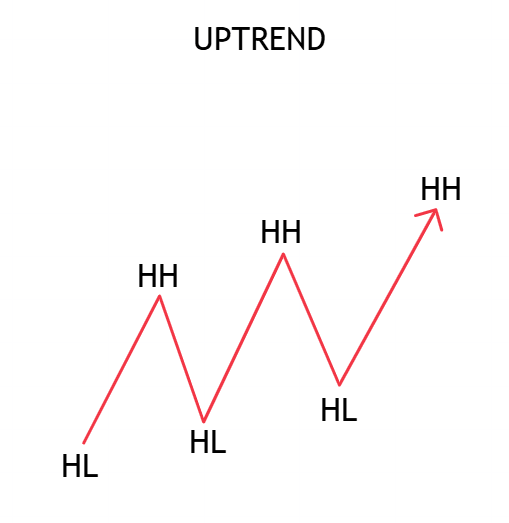
In an uptrend, price forms:
- Higher highs
- Higher lows
This simply means buyers are in control and pushing the market up.
When you see an uptrend, your main focus should be looking for buying opportunities, not selling.
Downtrend (Bearish Market)
A downtrend means the market is moving downward.
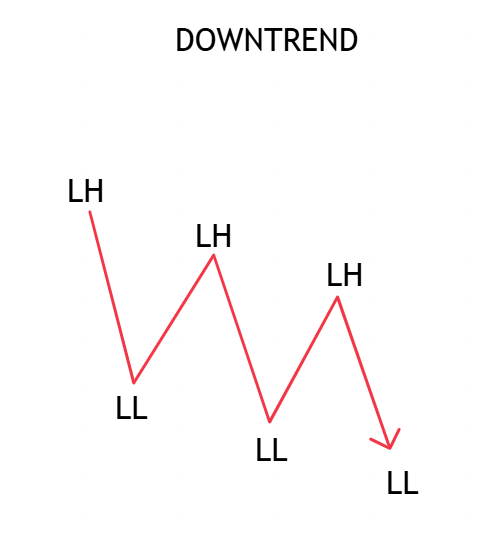
In a downtrend, price forms:
- Lower highs
- Lower lows
This shows that sellers are in control.
In this condition, you should focus more on selling opportunities rather than buying.
Sideways Market (Ranging Market)
A sideways market happens when price is moving within a range without a clear direction.
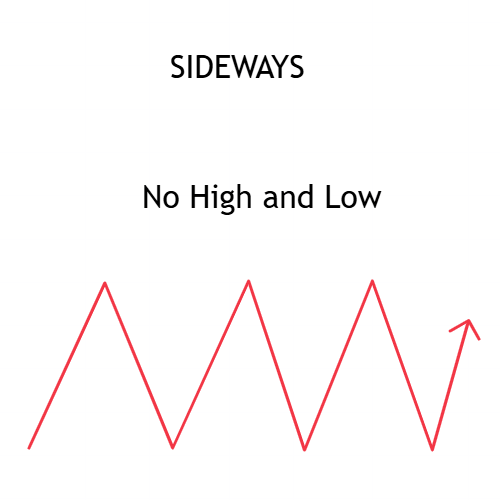
Price keeps bouncing between support and resistance without making higher highs or lower lows.
This is where many beginners get confused because the market has no clear trend.
I used to trade aggressively in this condition and got trapped often. Later, I learned that sometimes the best decision is to wait.
This is where the market likes to test your patience.
Understanding market trends helps you trade with direction instead of against it.
Trading without knowing the trend is like trying to swim against a strong current. It is possible, but very difficult.
You don’t try to catch a falling knife, you move with the tides.
Trends help you:
- know whether to buy or sell
- avoid unnecessary losses
- improve timing
- trade with confidence
When you follow the trend it increases your probability of success.
How to Identify Market Trends Easily
Identifying trends is simple when you follow a structured approach.
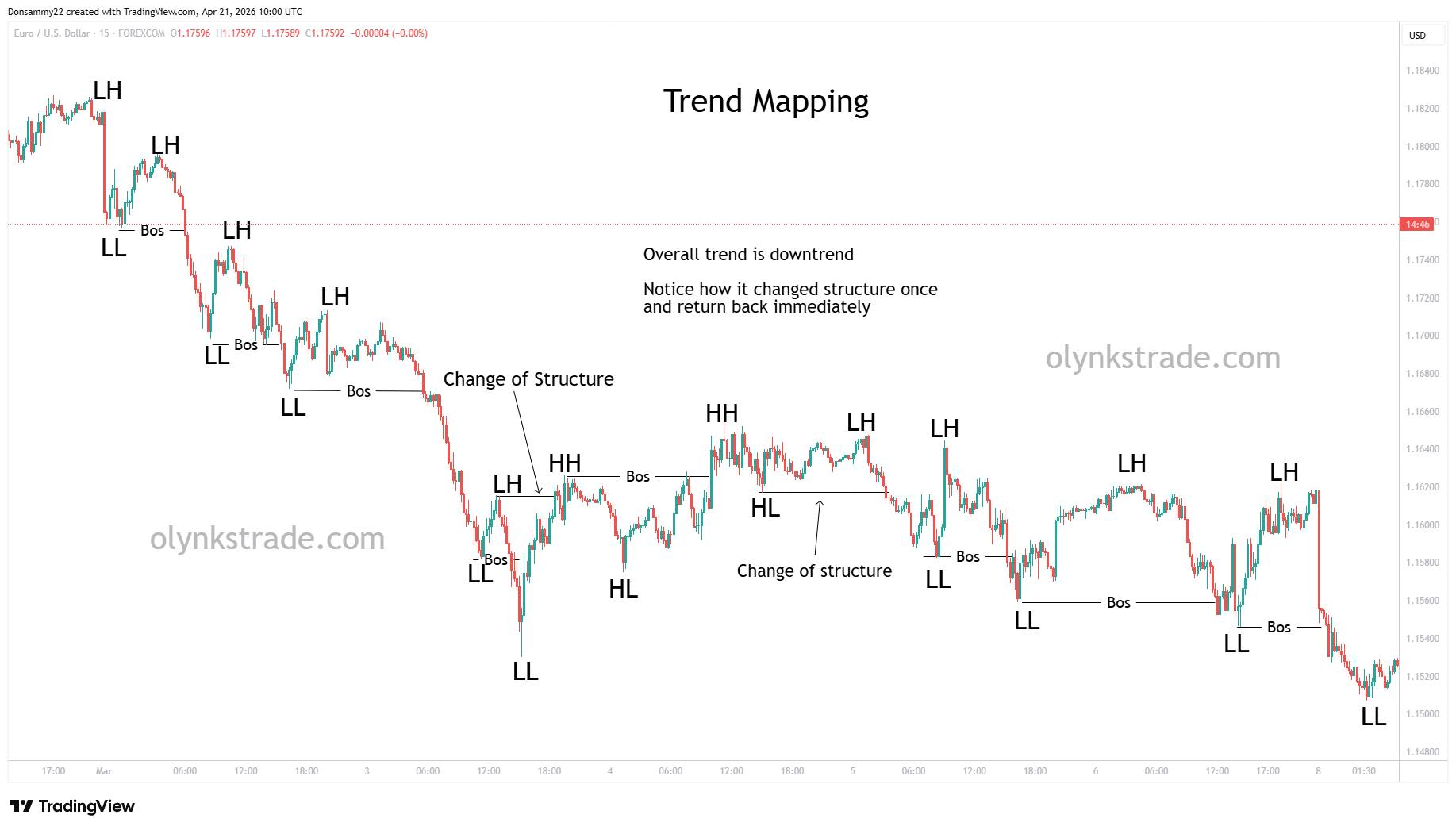
Note: Bos (Break of structure)
Look at the Market Structure
The easiest way to identify a trend is by looking at how price moves.
If price is making higher highs and higher lows, it is an uptrend.
If price is making lower highs and lower lows, it is a downtrend.
If price is moving within a range, no highs and lows then it is a sideways market.
Use Multiple Timeframes
Timeframe plays an important role in trend analysis.
A trend on a higher timeframe is stronger than a trend on a lower timeframe.
For example, if the daily chart is in an uptrend, it is safer to look for buying opportunities even if the lower timeframe shows temporary pullbacks.
Wait for the lower timeframe to move in the direction of the higher timeframe, then take your entry.
This is called top-down analysis.
Breaking down your timeframe analysis, use:
1W – 1D – 1H
1D – 1H – 5M
4H – 15 – 3M/1M
Combine with Support and Resistance
Support and resistance help confirm trends.
In an uptrend, price often breaks the resistance then comes back to respects support levels and continues upward.
In a downtrend, price breaks support then reacts at resistance and continues downward.
This is where everything you have learned starts connecting.
To deepen your understanding, you can also check this guide on how support and resistance levels work in trading.
Trend Trading Strategy for Beginners
A simple way to trade trends is to follow the direction of the market.
To Buy in an Uptrend
In an uptrend, wait for price to pull back to a support level, then look for a bullish candlestick pattern before buying.
To sell in a downtrend
In a downtrend, wait for price to move up to a resistance level, then look for a bearish pattern before selling.
This method combines:
- trend direction
- support and resistance
- candlestick confirmation
trading with confluences, increases your winning probability.
Change of Structure (Trend Change)
Trends do not last forever.
A trend can change when the market changes its structure.
For example, in an uptrend, if price stops making higher highs and breaks below a previous low, it may signal a possible trend reversal.
The same applies to a downtrend. Check the trend mapping image to see
Understanding this helps you avoid staying in a trade when the market direction has changed.
Many beginners make mistakes when trying to identify trends.
One mistake is trading against the trend. This increases risk and reduces probability.
Another mistake is switching bias too quickly. Just because one candle moves in the opposite direction does not mean the trend has changed.
Some traders also ignore higher timeframes and focus only on small movements.
At my early stage, I made all these mistakes. I used to change direction based on emotions instead of structure. Don’t make same mistake.
Quick Assessment
If the market is making higher highs and higher lows, what is the trend?
Uptrend.
If price is bouncing between support and resistance without clear direction, what is it?
Sideways market.
This simple understanding already puts you ahead of many beginners.
What You Should Learn Next
Now that you understand market trends in forex, the next step is learning how to combine trend, support and resistance, and candlestick patterns into a complete trading setup.
Key Takeaway
Market trends help you understand the direction of the market.
Instead of guessing, you follow what the market is already doing.
When you combine trend analysis with support and resistance and candlestick patterns, your trading becomes more structured and less emotional.
Take your time to practice identifying trends on different charts and timeframes.
learn more about forex market trends
https://www.ig.com/en/trading-strategies/what-is-a-trend-and-how-do-trends-work–190717

Leave a Reply to Powerful Risk Management in Forex, Techniques Every Beginner Must Know (2026 Guide) Cancel reply