
If you have ever taken a good trade and closed it too early, or watched a bad trade run until it wiped out your profit, then you have already experienced forex trading psychology.
This is the part nobody talks about enough.
Back when I didn’t understand this properly, I thought my problem was strategy. I kept searching for better entries, better indicators, better setups.
But the real issue was not the strategy.
It was me.
There was a time I would see a setup, hesitate, miss the move, then jump in late because I did not want to miss out. Other times, I would enter too early without confirmation and get stopped out.
That cycle kept repeating.
This is where most beginners get caught off guard.
In this guide, you will learn forex trading psychology for beginners in a simple and practical way so you can control your emotions and become a more consistent trader.
Table of Contents
What Is Trading Psychology?
Forex Trading psychology refers to the emotions and mindset that influence your trading decisions.
It is how you react to:
- wins
- losses
- market movement
- uncertainty
No matter how good your strategy is, if your mindset is not stable, your results will not be consistent.
In simple terms, trading psychology is what controls your behavior in the market.
Importance of a good Forex Trading Psychology
Many traders think success comes from strategy alone.
That is not true.
Two traders can use the same strategy and get completely different results. The difference is usually psychology.
Forex Trading psychology helps you:
- stay disciplined
- avoid emotional decisions
- follow your trading plan
- remain consistent over time
If you ignore this, even the best system will fail.
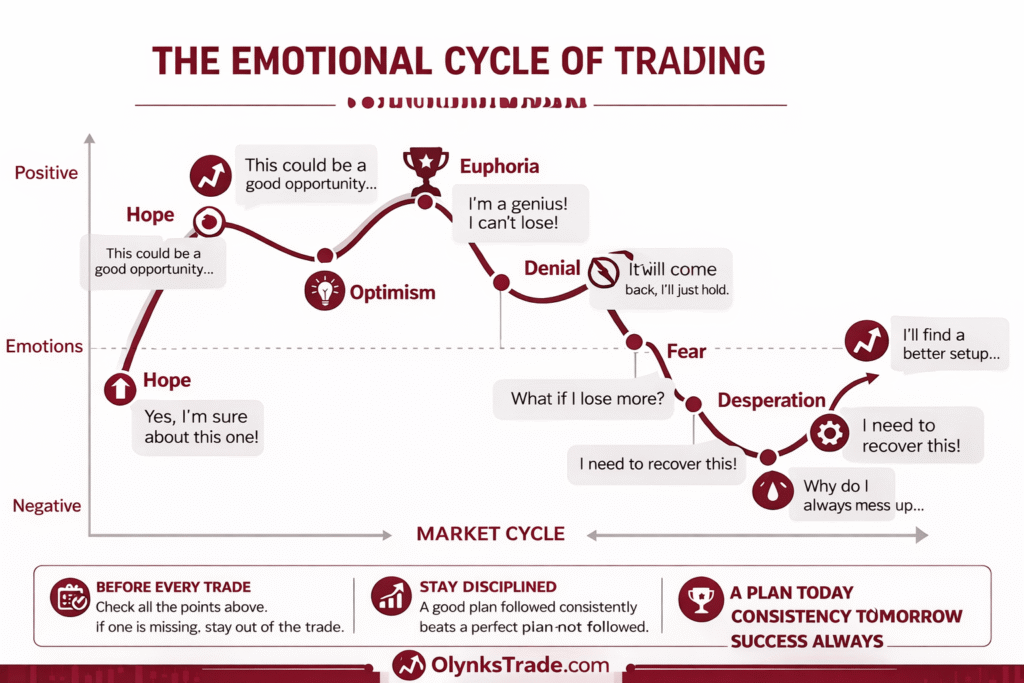
The 5 Emotions That Control Every Trader
Let’s break down the most common emotions that affect trading.
1. Fear
Fear is one of the biggest problems beginners face.
It shows up when:
- you are scared to enter a trade
- you close trades too early
- you hesitate even when your setup is valid
I remember struggling with this. I would see a perfect setup based on my plan, but I would still hesitate. By the time I entered, the move was already gone.
Fear usually comes from lack of confidence or past losses.
2. Greed
Greed makes you want more, even when you already have enough.
It shows up when:
- you refuse to take profit
- you increase lot size unnecessarily
- you overtrade
At some point, I realized I was not losing because I did not have opportunities. I was losing because I was trying to squeeze too much out of every trade.
3. Overtrading
Overtrading happens when you take too many trades without proper setups.
This usually comes from boredom or the need to “be in the market.”
If you blinked, you probably missed that move.
And instead of waiting for another setup, you jump into anything you see.
This leads to unnecessary losses.
4. Revenge Trading
This is one of the most dangerous habits.
After losing a trade, you immediately try to win it back.
You abandon your plan and start forcing trades.
I made this mistake more times than I can count. One loss would turn into multiple losses because I refused to step back.
5. Overconfidence
After a few wins, you start feeling like you cannot lose.
You ignore your rules.
You increase your risk.
Then the market reminds you very quickly.
Balance is key.
How to Control Your Trading Emotions
Now let’s talk about solutions.
Because knowing the problem is not enough.
1. Follow a Trading Plan
This is where your forex trading plan becomes powerful.
If you have read your guide on how to create a forex trading plan, you already know your rules.
Your job is simple:
follow them.
A plan removes decision-making pressure during live trading.
2. Use Proper Risk Management
Risk management reduces emotional pressure.
When you risk only 1% per trade, losses become easier to handle.
This connects directly with what you learned in your risk management guide.
Small risk = less stress = better decisions.
3. Accept That Losses Are Normal
This is something every trader must understand.
Losses are part of the game.
Even the best traders lose.
Once you accept this, you stop reacting emotionally to every loss.
4. Avoid Watching Every Tick
Staring at the chart every second increases anxiety.
You start reacting to small movements that do not matter.
Set your trade, define your risk, and let the market do its thing.
5. Stick to High-Quality Setups
Not every market condition is worth trading.
Focus on:
- clear trends
- strong support and resistance
- proper confirmation
This ties back to what you learned in:
- How to Identify Market Trends in Forex
- Support and Resistance in Forex
- Candlestick Patterns for Beginners
This is how you reduce unnecessary trades.
The Discipline Formula
Let me simplify it for you.
Good trading psychology =
Clear plan + Controlled risk + Discipline
Remove one, and everything starts to break.
Common Mistakes Beginners Make
Many beginners struggle with psychology because:
- they do not have a plan
- they risk too much
- they chase the market
- they try to recover losses quickly
This is one of those moments that separates guessing from understanding.
If you fix your mindset, your results will improve.
Real-Life Scenario
Imagine this:
You enter a trade based on your plan.
Price moves slightly against you.
You panic and close early.
Then price moves in your original direction.
You feel frustrated and jump back in late.
Now the market reverses again.
You lose twice.
This is not a strategy problem.
This is a psychology problem.
Quick Assessment
If you lose a trade, should you immediately enter another one to recover your loss?
No.
If your plan says risk 1%, should you increase it because you feel confident?
No.
Consistency comes from discipline, not emotions.
What You Should Learn Next
Now that you understand forex trading psychology, the next step is learning how to build a complete beginner trading strategy.
This is where everything comes together.
Key Takeaway
Trading psychology is what separates beginners from consistent traders.
It is not just about what you know.
It is about how you behave.
Once you learn to control your emotions, follow your plan, and stay disciplined, your trading will become more stable and more consistent.
Take this seriously.
This is where real growth happens.
understand more about trader mindset and emotional discipline https://www.ig.com/en/trading-strategies/trading-psychology-explained-190218

Leave a Reply