Table of Contents
Introduction
If you are wondering how much money needed to start forex trading, the answer might surprise you.
One of the most common questions beginners ask is about the capital needed to start forex. Some people believe they need thousands of dollars before they can become successful traders, but that is not always true.
Honestly, you do not need money to start forex trading.
I know that sounds strange because everywhere online people are asking:
“Can I start forex with $10?”
“Can I start forex with $50?”
“Can I start forex with $100?”
But in my opinion, those are the wrong questions.
The better question is:
Do you have enough knowledge to trade forex profitably?
Because having capital without knowledge is like giving a brand-new driver a Formula 1 car.
The car is available.
The opportunity is available.
But the skill is missing.
And when the skill is missing, the outcome is usually predictable.
Many beginners focus too much on account size and too little on education.
They spend weeks looking for money to fund a trading account while spending very little time learning how the market actually works.
The truth is that forex trading is one of the few businesses where people want to skip the learning phase completely.
Nobody opens a restaurant without learning the business first.
Nobody becomes a doctor without studying first.
Yet many people want to fund a trading account today and become profitable tomorrow.
The market usually has a different plan.
In this guide, you will learn how much money you need to start forex trading and why knowledge should always come before capital.
How Much Money Needed to Start Forex Trading?
The honest answer is simple:
You need knowledge before you need capital.
When people search for the minimum capital for forex trading, they are usually expecting a specific dollar amount. However, the reality is that your trading knowledge matters far more than your starting balance.
Before thinking about deposits, profits, or account sizes, you should focus on learning:
- market structure
- risk management
- trading psychology
- trading plans
- technical analysis
- emotional control
The Biggest Mistake Beginners Make
Many beginners become obsessed with how much money to start forex instead of focusing on developing the skills required to manage that money properly.
I made this mistake during my beginner stage too.
I used to think:
“If I can turn $10 into $20, then if I get a bigger account, I will become rich.”
That mindset made me focus on funding accounts instead of improving my skills.
I kept funding account after account until I eventually ran out of money.
That was when it finally hit me that I needed to figure out what I was doing wrong.
The problem was never my capital.
The problem was my lack of experience and understanding.
Looking back now, one of the biggest things I was missing was proper risk management. I was so focused on making money that I completely ignored protecting my account. If you have not read it yet, Understanding Risk Management in Forex explains why protecting your capital is more important than chasing profits.
Ironically, by the time I became confident in my skills after spending months on demo, I no longer had enough money to fund a live account.
That experience taught me a lesson I will never forget:
Knowledge comes before capital.
Well, i later picked up without funds… you must be curious to know how, you will find out towards the end of the article.
Demo Trading Costs Nothing
One thing many beginners forget is that you can start learning forex completely free.
Most brokers provide demo accounts that allow you to practice with virtual funds, and there is plenty of free educational content available online and on social media.
You can:
- learn chart analysis
- test strategies
- practice risk management
- build confidence
without risking real money.
This is why I always encourage beginners to focus on learning first instead of rushing into live trading.
If you have not already read it, check out Demo vs Live Trading in Forex to understand the difference between practicing and trading real money.
Why Knowledge Is More Valuable Than Capital

Let me put it this way.
If someone had given me $10,000 when I first started trading, I probably would have lost most of it.
Not because I lacked motivation.
Not because I lacked confidence.
But because I lacked experience.
Back then I was still learning:
- discipline
- patience
- emotional control
- proper execution
A larger forex trading account size does not automatically make someone a better trader. In many cases, traders who lack discipline lose large accounts faster than disciplined traders lose small ones.
Knowledge protects capital.
Capital alone cannot protect itself.
That is why successful traders focus heavily on learning first.
Once you know what you are doing, finding capital becomes much easier.
What Is the Best Account Size for Beginner Forex Traders?
Many traders lose money not because they started with a small account.
They lose money because they funded an account before they understood what they were doing.
I have seen many traders make excuses that the reason they keep losing money in trading is because their capital is too small. I usually just smile.
If you cannot manage a small account, you will probably struggle even more with a larger account because the psychological pressure becomes greater.
Your first investment should be in education, not capital.
You Can Win Prop Firm Challenges and Giveaways
Here is the answer I promised earlier.
If you have followed this article to this point, congratulations—you are serious about improving your trading journey.
There was a period when I had developed my skills but had very little capital available.
I had the skill but no capital.
Instead of giving up, I started looking for opportunities.
One of those opportunities was trading giveaways and prop firm promotions on X (formerly Twitter).
One day, Instant Funding organized a competition where traders received a $5,000 one-step challenge account. The first 5,000 traders who passed the challenge were allowed to keep the account.
I participated.
I passed.
I was among the winners, and I received several payouts from that $5,000 account.
Those payouts later helped me purchase larger funded accounts and continue growing.
Now imagine if I had won that account without the necessary trading knowledge.
I probably would have lost it quickly.
That experience reinforced the same lesson once again:
Knowledge first.
Capital second.
Consider a Side Job Instead of Rushing a Trading Account
This might not be the exciting answer people want to hear, but it is often the smartest answer.
If you currently have little or no capital, consider building your skills while working a side job or another source of income.
This approach removes a lot of pressure.
Many beginners enter forex with unrealistic expectations because they desperately need trading profits immediately.
That pressure creates emotional decisions.
And emotional decisions rarely end well.
A side income gives you:
- patience
- flexibility
- less emotional pressure
- more time to learn properly
There is nothing wrong with building your trading knowledge while gradually preparing capital.
In fact, it is often the safer path.
Why Successful Traders Focus on Skills Before Capital
One thing I have noticed over the years is that traders who survive long-term usually prioritize skills over money.
They understand that money follows skill.
Not the other way around.
The market rewards:
- discipline
- consistency
- patience
- education
far more than excitement.
Many traders spend months searching for capital.
Very few spend the same amount of time searching for knowledge.
Ironically, knowledge is usually what creates opportunities later.
Focus on Becoming a Better Trader First
At the beginning of your journey, your goal should not be:
“How much money can I make?”
Your goal should be:
“How much can I learn?”
That mindset changes everything.
Instead of chasing quick profits, you start focusing on:
- building experience
- understanding the market
- improving execution
- developing discipline
Over time, those skills become more valuable than any small deposit you could make today.
How I Went from Zero Capital to a $100,000 FTMO Funded Account
If you’re waiting until you have thousands of dollars before taking forex seriously, this story is for you.
This isn’t another “get rich overnight” story. It’s the journey of how focusing on knowledge before capital eventually opened the door to managing a $100,000 FTMO funded account.
People often ask me how I managed to get a $100,000 FTMO funded account when I didn’t even have money to start trading.
The truth is, my journey was far from easy.
Like many beginners, I almost lost everything while trying to figure out my trading edge.
Before I became a full-time trader, I worked as a phone technician. Every time I saved enough money, I would buy another prop firm challenge, hoping this would finally be the one.
Unfortunately, it wasn’t.
I ended up blowing more than 10 to 15 prop firm accounts that I paid for with my own hard-earned money.
Each failure taught me something, but it also drained my finances.
Eventually, I reached a point where I made a promise to myself:
I would never fund another prop firm challenge with my personal money until I truly understood what I was doing.
Instead, I shifted my focus completely to demo trading. I wanted to build a repeatable strategy before risking another dollar.
That single decision changed everything.
The Opportunity That Changed My Journey
While spending more time on X (formerly Twitter), I started noticing that many prop firms and trading influencers regularly hosted free prop firm giveaways.
At first, I didn’t pay much attention to them.
After all, thousands of traders enter these giveaways every time.
What were my chances?
Still, I decided to give it a try.
To my surprise, I started winning.
Not just once.
Over time, I won more than 15 free prop firm accounts through giveaways.
Now, let me be honest.
I still blew many of those free accounts.
But this time, something was different.
I wasn’t losing my own money anymore.
Every failed account became another opportunity to learn, improve, and refine my strategy without putting additional pressure on my finances.
Eventually, all those lessons paid off.
I was among the 500 traders who finally successful passed and got funded by instantfunding one phase account from a giveaway more than 200,000 traders participated.
That moment completely changed my trading journey.
I made some couple of payout and i was able to buy a bigger account, the rest was history.
Looking back today, I can confidently say that focusing on knowledge before capital was one of the best decisions I ever made.
How I Increased My Chances of Winning Prop Firm Giveaways on X
Many people think winning giveaway accounts is purely luck.
In my experience, that’s only partly true.
Most influencers choose winners in one of two ways:
- Randomly using a Twitter/X picker.
- Manually selecting active followers they consistently recognize.
Personally, every prop firm giveaway I won came from being an active follower.
The random picker never seemed to favor me.
So if you want to improve your chances, here’s exactly what I did.
Below are screenshot of some of the giveaways i won
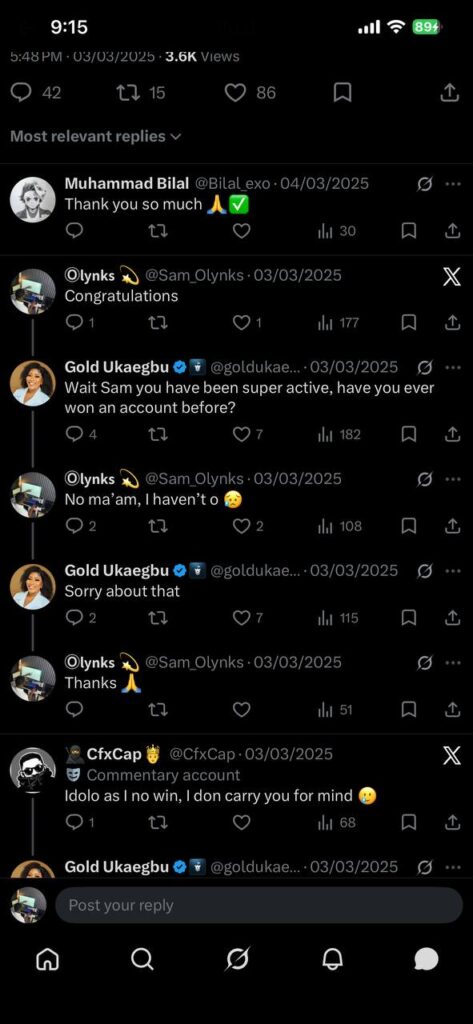
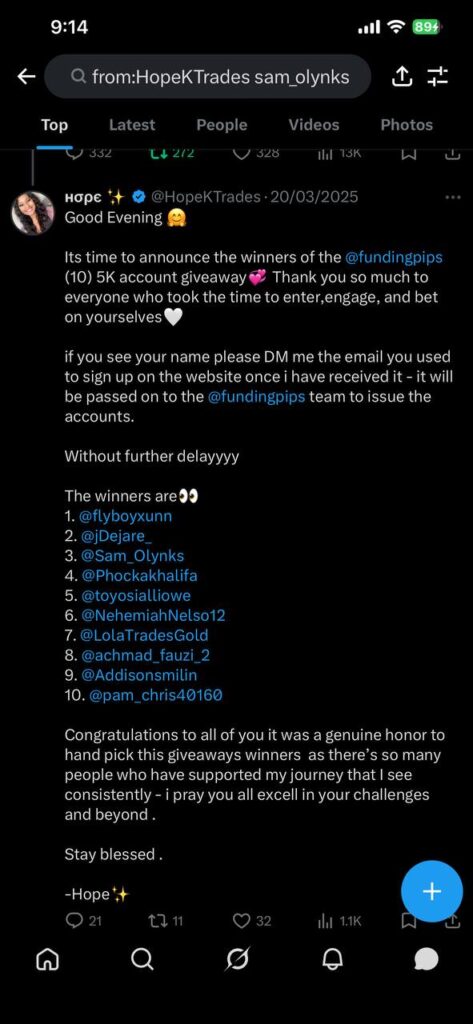
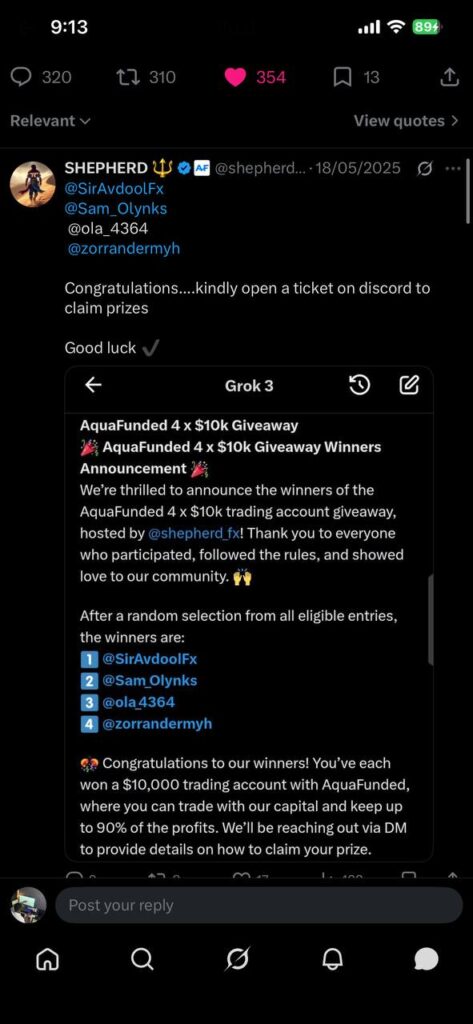
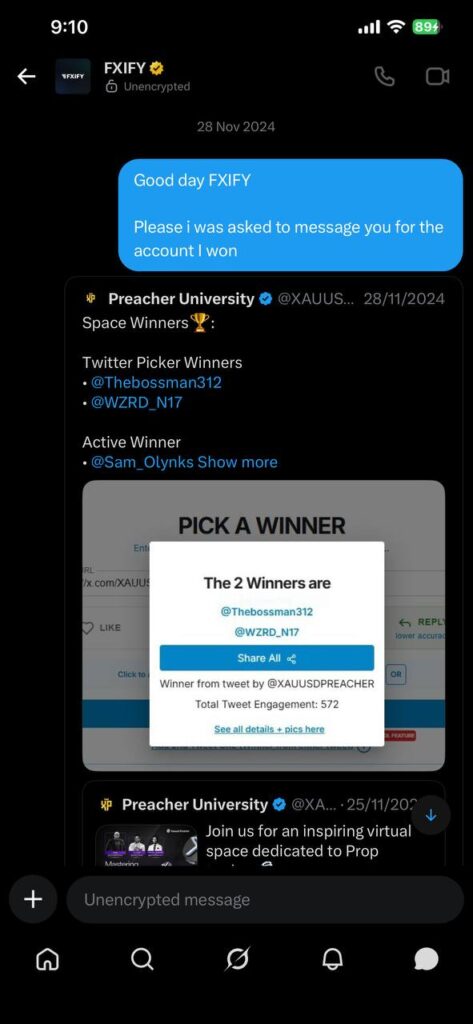
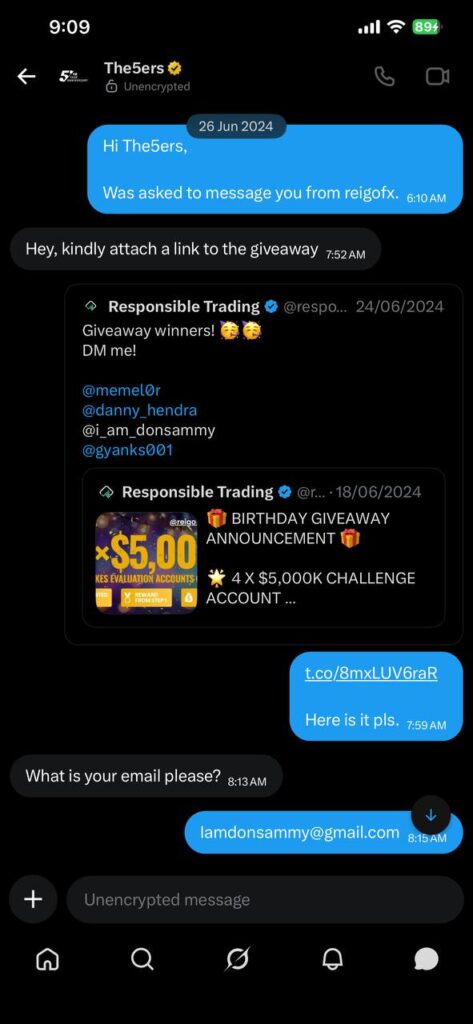
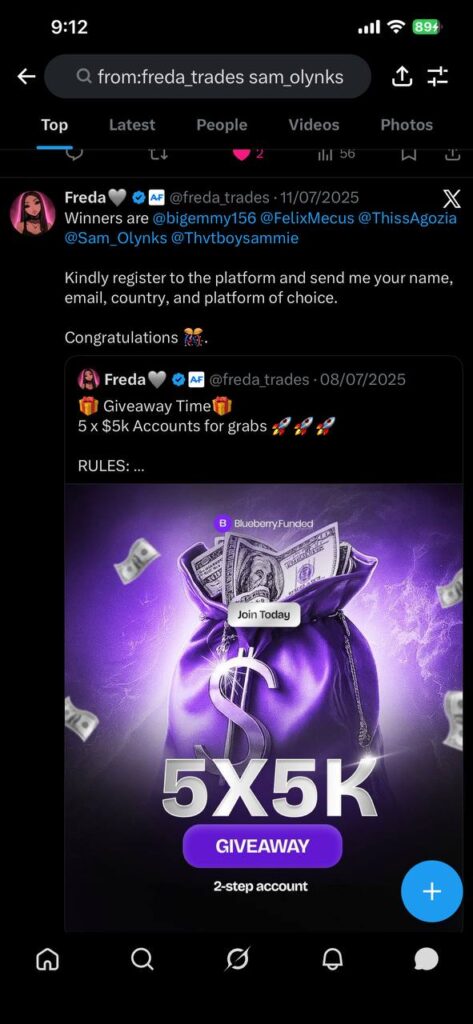
Note my usernames was I_am_donsammy before i later changed to sam_olynks.
Now lets continue.
1. Find the Right Influencers
Spend some time researching prop firm companies and trading influencers who regularly host giveaways.
More importantly, pay attention to how they choose winners.
Some always use random pickers.
Others prefer rewarding active members of their community.
Focus on the second group.
2. Follow Them and Become Visible
Once you’ve found them:
- Follow their accounts.
- Turn on post notifications.
- Like at least 20 of their previous posts.
The goal isn’t to spam.
The goal is to become familiar enough that they recognize your name whenever you engage.
3. Be Consistently Active
This is where most people fail.
Whenever they post, try to be among the first few people to:
- Like the post.
- Leave a genuine comment.
- Join conversations when appropriate.
Over time, your name becomes familiar.
And when they decide to reward active followers, your chances increase significantly.
Consistency is what made the biggest difference for me.
Remember the Most Important Part
Winning a free prop firm account is only half the battle.
Keeping it is the real challenge.
While you’re hunting for giveaway opportunities, spend even more time improving your trading knowledge.
Study.
Practice.
Backtest.
Refine your strategy.
Because sooner or later, you’ll receive an opportunity.
When that moment comes, you want to be prepared.
Knowledge is what turns a free account into a funded account.
Final Thoughts
If this approach helps you win your first prop firm giveaway, I’d genuinely love to hear about it.
Feel free to share your experience or tag me on X.
I enjoy seeing traders grow, especially those who started with little or no capital—just like I did.
I wish you all the very best on your trading journey.
Good luck, traders.
Key Takeaway
If you are asking, “How much money do you need to start forex trading?”, my answer is simple:
You do not need money to start learning forex.
You need knowledge first.
Capital without knowledge usually disappears.
Knowledge without capital can eventually attract opportunities.
Whether that opportunity comes from a personal account, a side income, a prop firm challenge, or a funded account giveaway, the foundation remains the same.
Learn first.
Practice first.
Build your skills first.
Use the above method to get yourself an account then scale.
Because in forex trading, knowledge is the real capital.
If you want a broader overview of how the forex market works before funding a live account, this beginner-friendly guide from FOREX.com Trading Education Center explains many of the core concepts new traders should understand.

Leave a Reply