

If you keep jumping into trades without a clear plan, you are not trading, you are guessing.
A good forex trading plan is what turns random decisions into structured actions.
Early in my trading journey, I used to take trades based on how I felt in the moment. If the market looked like it was moving, I entered. If I saw a candlestick pattern, I jumped in.
I had no preferred pairs. Any pair I saw was what I traded. There was no position size calculation. I used random lot sizes, and sometimes I even increased my lot size to recover previous losses.
There was no consistency.
Some trades worked, many did not. And the truth was simple, I had no plan.
Everything changed when I started following a structured approach. Instead of reacting to the market, I started preparing for it.
In this guide, you will learn how to create a forex trading plan in a simple and practical way so you can trade with confidence and consistency.
Table of Contents
What Is a Forex Trading Plan?
A forex trading plan is a set of rules that guides your trading decisions.
It tells you:
- when to enter a trade
- when to exit a trade
- how much to risk
- what conditions must be met before taking a trade
Instead of making emotional decisions, you follow a clear process.
A trading plan removes guesswork and replaces it with discipline.
Why Every Trader Needs a Trading Plan
Without a plan, trading becomes inconsistent.
You might win today and lose tomorrow, not because the market changed, but because your decisions are not structured.
A trading plan helps you:
- stay disciplined
- reduce emotional trading
- follow a consistent strategy
- improve long-term performance
At some point, I realized that consistency in trading does not come from luck. It comes from following rules and repeating the same process over and over.
The Steps to Create a Forex Trading Plan
Now let’s break it down into simple steps you can follow.
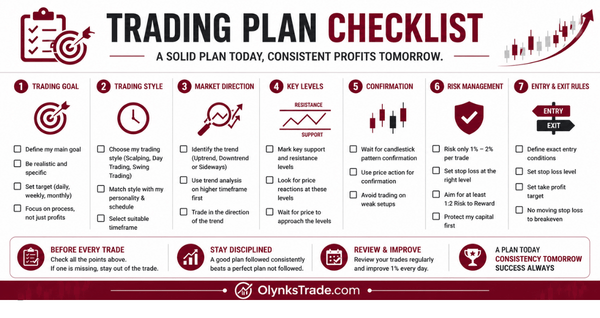
Step 1: Define Your Trading Goal
Before you start trading, you need to know what you want to achieve.
Are you trading to:
- grow a small account
- learn and gain experience
- generate consistent income
Your goal will determine your approach.
Be realistic. Trading is not a get-rich-quick scheme.
Step 2: Choose Your Trading Style
Your trading style determines how often you trade and how long you hold positions.
Common styles include:
- scalping (short-term)
- day trading
- swing trading
Your style should match your personality and schedule.
For example, if you do not have time to monitor charts frequently, lower timeframes may not be suitable.
This connects with what you learned in your chart guide about timeframe selection.
Step 3: Identify Market Direction
Before entering any trade, you must know the direction of the market.
This is where your knowledge from How to Identify Market Trends in Forex becomes important.
If the market is in an uptrend, focus on buying.
If the market is in a downtrend, focus on selling.
Trading with the trend increases your probability of success.
Step 4: Mark Key Levels
Next, identify important areas where price is likely to react.
This is where your How to Identify Support and Resistance in Forex guide comes in.
Wait for price to approach these levels before looking for trades.
This helps you avoid entering randomly.
Step 5: Wait for Confirmation
Do not enter a trade just because price reaches a level.
Wait for confirmation using price action.
This is where Candlestick Patterns for Beginners becomes useful.
For example:
- bullish pattern at support → potential buy
- bearish pattern at resistance → potential sell
This step filters out weak setups.
Step 6: Define Your Risk Management Rules
This is one of the most important parts of your trading plan.
Decide:
- how much you will risk per trade (1%–2% recommended)
- your risk to reward ratio
- where your stop loss will be placed
Everything here should align with what you learned in your risk management guide.
A good plan protects your account first before aiming for profit.
Step 7: Set Entry and Exit Rules
Your trading plan must clearly define:
- exact entry conditions
- stop loss placement
- take profit target
No guessing.
If your rules are not clear, you will fall back into emotional trading.
All the steps above can be adjusted to match your strategy and the kind of trader you are.
Example of a Simple Trading Plan
Let’s put everything together.
You decide to:
- trade in the direction of the trend
- wait for price to reach support or resistance
- confirm with candlestick patterns
- risk 1% per trade
- aim for at least a 1:2 risk to reward
- avoid moving to breakeven unnecessarily; allow trades to reach either stop loss or take profit
This simple structure is enough to remove emotional trading and build consistency.
Common Mistakes Beginners Make
Many beginners struggle with trading plans.
One mistake is creating a plan but not following it.
Another mistake is overcomplicating the plan with too many rules and indicators.
Some traders also change their plan after every loss.
I made this mistake many times. After a losing trade, I would doubt my plan and start adjusting things randomly. That only made things worse.
A good trading plan should be simple and consistent.
The Psychology Behind a Trading Plan
A trading plan helps you stay disciplined.
Without it, emotions like fear and greed take control.
With a plan, you already know what to do before the trade even happens.
This reduces stress and improves decision-making.
Quick Assessment
If your plan says you only trade in an uptrend, should you sell in a downtrend setup?
No.
If your plan says you risk 1% per trade, should you risk 10% because you “feel confident”?
No.
A trading plan only works if you follow it.
What You Should Learn Next
Now that you understand how to create a forex trading plan, the next step is learning trading psychology.
This will help you control your emotions and stick to your plan.
Key Takeaway
A forex trading plan is what brings structure to your trading.
It helps you move from guessing to making calculated decisions.
Once you have a plan and follow it consistently, your trading becomes more stable and predictable.
Take your time to build your plan and stick to it.
learn more on how to build a structured trading plan https://www.forex.com/en-us/education/education-themes/trading-strategy/how-to-create-a-trading-plan/

Leave a Reply